
Artificial Turf Field
 |  |
ADSS ARTIFICIAL TURF FIELD REPLACEMENT PROJECT
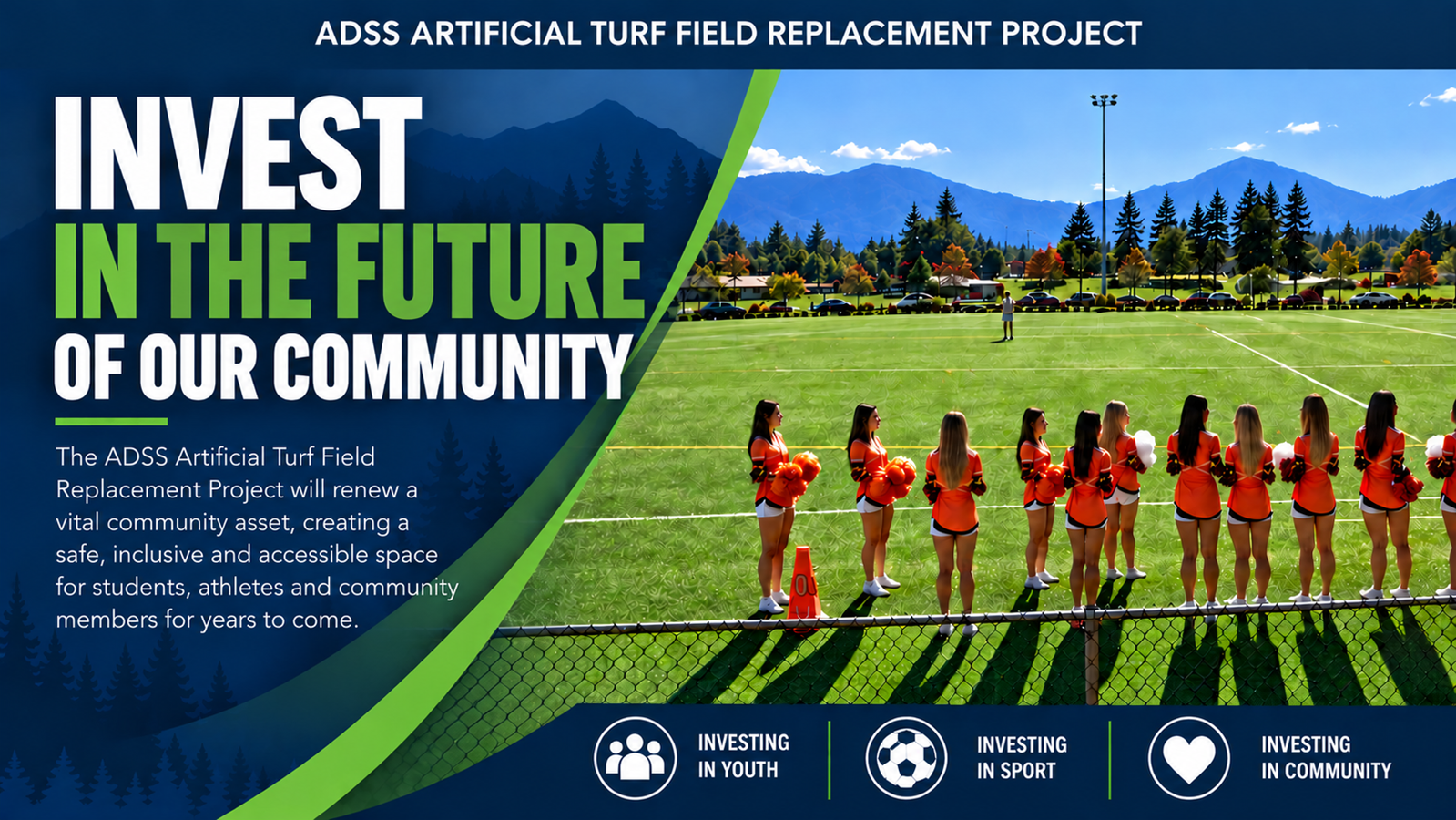
The artificial turf field at Alberni District Secondary School is more than a school facility—it is a shared community asset that supports students, athletes, families, local sport organizations and recreational users from across the Alberni-Clayoquot region. Installed in 2012, the field has now reached the end of its expected service life and requires replacement to ensure it remains safe, reliable and available for continued school and community use. Pacific Rim School District is working alongside community and government partners to find a shared solution for this important regional recreation facility. The District has committed funding toward the project and is also seeking grants, sponsorships and community support to help make the replacement possible.
Want to learn more? Explore the Sponsorship Package and the Frequently Asked Questions section below to learn about the field, who uses it, why replacement is necessary, how the project will be funded, and how future replacement costs will be planned for. The Sponsorship Commitment Form is available either on the last page of the Sponsorship Package, or online at Sponsorship Commitment Form – Fillable Online.

FREQUENTLY ASKED QUESTIONS
Why does the artificial turf field need to be replaced?
The field was installed in 2012 and is now approximately 14 years old. Artificial turf fields typically have an expected service life of approximately 10 to 12 years, depending on use, maintenance and other conditions. The existing field is now beyond its expected service life, with increasing safety and drainage concerns. An engineering review has recommended replacement.
Unlike a natural soil and grass field, where worn, uneven or damaged areas can generally be repaired, regraded, reseeded or resodded as part of ongoing maintenance, an artificial turf system has a finite service life. As the turf system ages, deterioration of the fibres, infill, drainage and impact-attenuation characteristics can reach a point where routine maintenance or localized repairs are no longer sufficient to reliably address the condition of the overall playing surface. At that stage, replacement of the turf system becomes necessary rather than simply continuing to repair individual areas.
Given the age of the existing field, its condition and the findings of the engineering review, replacement is increasingly important to ensure the facility can continue providing a safe, reliable and all-weather playing surface for students and community users.
What happens if the field isn't replaced?
Continued operation of the existing surface is not sustainable indefinitely. Without replacement, community access to the facility will ultimately need to be restricted or discontinued.
The impacts would extend beyond ADSS. Field hockey programming could be lost because the artificial turf is the only suitable facility for that programming in Port Alberni. Soccer programming would also be significantly reduced and displaced onto local grass fields.
That displacement would create additional pressure on other recreational facilities, particularly during the fall and winter months when heavy rainfall already limits the sustainable use of natural grass fields.
Who uses the field?
The artificial turf field serves a significant number of school and community users. During the school day, it supports the physical and health education curriculum and daily instructional activities for more than 1,300 ADSS students, as well as approximately 120–160 student athletes participating in school-based soccer and field hockey.
Community use includes approximately:
- 600 youth soccer participants from September through June;
- 60 adult soccer participants from September through March;
- 100+ youth field hockey participants; and
- 100+ community volunteers who help make this programming possible.
Approximately 39% of Alberni Athletics Soccer Club's roughly 600 youth registrants live outside the City of Port Alberni, including residents of the broader Alberni-Clayoquot Regional District and West Coast communities. Prime community use occurs outside the school day, generally from 5:00–9:00 p.m. on weekdays and 8:00 a.m.–8:00 p.m. on weekends.
Is this primarily a School District facility?
The school district owns the land and facility, and ADSS students are important users of the field. However, the field also serves substantial community recreation needs outside school hours.
It supports City of Port Alberni residents, residents from across the Alberni-Clayoquot Regional District, and regional sport organizations. For that reason, the school district views the artificial turf field as regional recreation infrastructure - an asset with shared responsibilities and broad community benefits.
Why don't you use another field?
Adjacent municipally owned fields can be, and are currently, used by school district students across the valley. Artificial turf fields are renowned for their all-weather playability. With 30cm of gravel and an extensive drainage system, the artificial turf field can host sports during a tremendous amount of rainfall and still be a safe, playable surface.
Why can't the artificial turf be replaced with a natural grass field?
Converting the site to natural grass is not a feasible alternative. The field is constructed above geothermal infrastructure, which limits the ability to use the heavy equipment required to properly construct, resurface, and maintain a natural grass field.
Natural grass would also provide significantly fewer playable hours. This is particularly important because much of the community's demand occurs during the fall and winter months, when the Alberni Valley experiences its heaviest rainfall.
Replacing the existing surface with artificial turf allows the site to continue supporting the level and variety of school and community use it currently accommodates.
Artificial turf fields have a negative environmental effect. Why are you proceeding with this route and how are you ensuring no impact?
The artificial turf field sits on a bed of 30cm of gravel and an intricate series of drainage pipe. No rubber or plastic infill or turf material will make it through the gravel to the water drainage system.
Due to this specialized gravel bed and drainage system, we cannot put a natural grass field in the same spot as the artificial turf field.
Beneath the surface of the artificial turf field, houses ADSS’s 300 geothermal loops that help make ADSS LEED (Leadership in Energy and Environmental Design) certified. Any excavation or removal of this gravel/ irrigation could run the risk of damaging this system.
How much will replacement cost?
Current estimates place the artificial turf replacement project at approximately $1 million. The school district is pursuing a shared funding approach involving the school district, local and regional government partners, community organizations, grants, fundraising and sponsorship.
The goal is not to place responsibility for the entire project on any one organization or group, but to develop a collaborative solution that reflects the broad community benefit of the facility.
Why doesn't the School District simply pay for the replacement from its regular budget?
School district funding is provided through separate funding streams, each with specific purposes and limitations. The school district's operating budget primarily supports staffing, educational programs, and the day-to-day operation of schools. Approximately 90% of operating expenditures are allocated to salaries and benefits.
The estimated $1 million cost of replacing the artificial turf represents a significant infrastructure expense that cannot reasonably be absorbed within the school district's operating budget without greatly affecting other priorities.
Artificial turf replacement is not eligible under the special-purpose funding available to school districts. Simply put, the usual existing school district funding structure does not provide a viable dedicated funding source for a project of this nature.
Why is the School District seeking community sponsorship for a district-owned field?
Because the benefits of the field extend well beyond the School District. Students use the field extensively during the school day, while evenings and weekends support significant community recreation. Soccer and field hockey organizations, athletes, families and residents from throughout the region rely on the facility.
Across Vancouver Island, artificial turf fields located on school property are commonly supported through partnerships involving school districts, local governments, community sport organizations, grants, sponsorship and fundraising. The school district believes shared community benefits are best supported through shared investment.
Have you looked for other grant funding?
The school district and its community partner group have applied for several grants. The Board continues to advocate for expanded provincial funding opportunities to support the renewal of important district assets that fall outside the scope of existing Major and Minor Capital funding programs, such as artificial turf field replacement. The Board appreciates the Ministry’s ongoing investment in public education infrastructure and welcomes opportunities to work collaboratively to identify sustainable funding solutions for these types of assets.
Have you approached the City of Port Alberni or the Alberni-Clayoquot Regional District for funding?
The Board of Education presented to the Alberni-Clayoquot Regional District early in 2026. The Regional District does not have a mandate to provide sports and recreation to its constituents. The City of Port Alberni Recreation Department staff regularly participate in our reoccurring partner group meetings around the artificial turf replacement project.
Do you charge user fees now? Are they adequate?
Through our Policy and Admin Procedure, user groups are charged rental fees for use of the artificial turf field. Part of the school district’s financial contribution towards resurfacing the Artificial Turf Field is coming from these rental fees.
In 2026, the school district evaluated our fees in comparison to other regional artificial turf fields and increased our rental rates to bring alignment across the region.
Why wasn't money set aside for the replacement when the field was built?
When the artificial turf field was originally provided by the Ministry of Education and Child Care in 2012, the school district did not establish a dedicated reserve for its eventual replacement. Like all school districts in British Columbia, Pacific Rim School District receives a finite amount of funding and must continually balance competing priorities across educational programming, staffing, student supports, facility operations, capital projects, and infrastructure renewal. The school district was not aware that replacement of this asset would not automatically qualify for any of the above-mentioned funding streams.
At the same time, community reliance on the facility grew considerably over the years without a corresponding long-term partnership or lifecycle funding model. Community rental rates were heavily discounted and did not generate sufficient revenue to build an adequate replacement reserve.
Asset-management practices have evolved considerably since the field was installed. The school district recognizes that a short-lifecycle asset of this size requires a different approach. That is why the school district is not simply looking at how to fund this replacement. It is also working toward a sustainable model so that the community is not facing the same funding challenge when the replacement surface reaches the end of its life.
Future options could include adjusted rental rates and user fees, annual contributions to a lifecycle replacement reserve, and lifecycle-planning requirements within joint-use agreements.
How is the School District managing its other buildings and assets?
The school district must continually plan for and prioritize the maintenance and renewal of schools, building systems, grounds and other infrastructure while working within the funding available for those purposes. These assets are annually planned for through the Major and Minor Capital Project funding streams mentioned earlier.
How often will the field need to be replaced?
Artificial turf has a considerably shorter lifecycle than many other types of public infrastructure. As mentioned previously, the existing surface has an expected service life of approximately 10–12 years. Looking ahead, the school district is planning on the basis that another renewal could be required in approximately 10–12 years, depending on the replacement product selected, usage and other factors.
An important part of the current project is therefore not only replacing the existing field but establishing a sustainable financial model for its eventual future replacement.
What is being done so this doesn't happen again in another 10–12 years?
This is an important part of the replacement project. The immediate priority is securing the funding necessary to replace the existing field. At the same time, the school district wants the replacement to be accompanied by a sustainable lifecycle funding model.
Potential components include:
- annual contributions to a dedicated lifecycle replacement reserve;
- adjusted community rental rates and user fees;
- contributions from participating partners; and
- lifecycle planning incorporated into future joint-use agreements.
Spreading replacement costs over the life of the asset makes the annual financial commitment much more manageable and helps ensure that funds are available when the next replacement is required.
Will the field be closed in December?
On December 16th, 2025, the Board of Education passed a motion that read. “THAT the Board approve that, subject to successful completion of annual safety compliance testing and the field remaining in safe operating condition, the ADSS Turf Field remain open for school and community use until December 31, 2026; and
THAT the Board approve that, if by December 31, 2026, a minimum of $1,000,000 has not been collectively raised by ADSS and participating community groups and a sustainability plan has not been presented to the Board, the Operations Department initiate planning to replace the existing surface with a non-irrigated natural grass field, with the understanding that timelines for grass installation may require limited continued use of the existing turf into Spring 2027.”
Since this Board motion, the Operations Department has determined that replacing the artificial turf field with real grass is not actually a viable option.
In November of 2026, another G-Max test will be conducted to test the field again for its safety and playability. Staff will then present the results to the Board of Education, along with all possible funding solutions.
How can I help?
Businesses, organizations, families and community members can support the ADSS Artificial Turf Field Replacement Project through the sponsorship and fundraising opportunities outlined in the Community Sponsorship Package. Every contribution helps protect an important regional recreation facility and ensures that students, athletes and community members can continue using the field for years to come. Sponsorship Commitment Form – Fillable Online
Will Charitable Receipts be Given?
Pacific Rim School District is registered with Canada Revenue Agency (CRA) as a charitable organization for the purpose of ‘Advancement of Education’ as defined in the Income Tax Act and is entitled to issue charitable receipts for income tax purposes for eligible donations.
